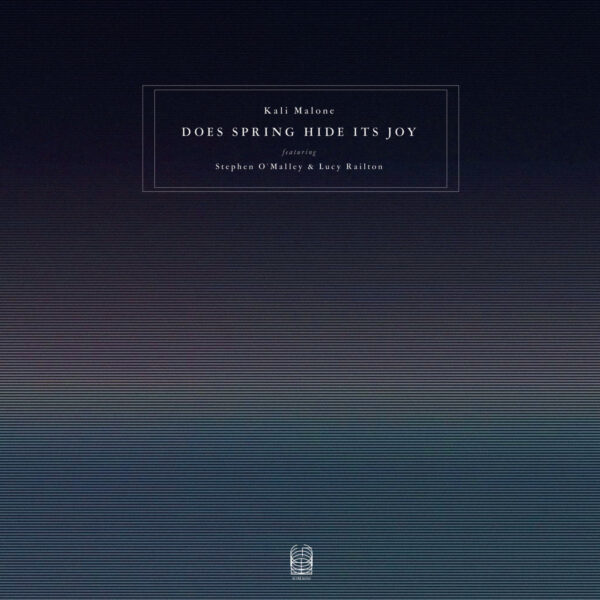
Kali Malone (featuring Stephen O’Malley & Lucy Railton), Does Spring Hide Its Joy, Ideologic Organ, SOMA 050, 3 x vinyl LPs / 3 x CDs (2023)
If you thought Kali Malone’s “The Sacrificial Code” was a monumental release of pipe organ drone – it lasts some two hours – then this follow-up release will floor you with its three-hour-plus running time of three versions of a dronescape piece she composed during the COVID-19 pandemic lockdown in 2020. The three variations were recorded by Malone, using sine wave generators instead of organ, during an extended jam with Stephen O’Malley on e-bowed guitar and Lucy Railton on cello at the MONOM studio in the Funkhaus Berlin.
As you might have suspected, for the most part these triplet pieces are not greatly different from one another as all three musicians listen carefully and follow one another closely, their instruments blending in sound and forming a steady harmony – though there are moments where you can actually identify (or think you can) an individual instrument. Lucy Railton’s cello seems more prominent early in Version 1 than on Version 2, and the latter plays slightly harder and a bit faster than Version 1 does. Malone and Railton are generally dominant throughout all three pieces, moving slowly yet steadily through moods of almost deathly quiet to powerful and booming. O’Malley tends to be quiet until all of a sudden, he springs a surprise with booming guitar that cuts across the sound built up by Malone and Railton.
The differences that do exist paradoxically have the effect of influencing the overall mood in each version and such influences even if some occur early on and don’t last for long, may nevertheless affect your perception of the entire track and whatever else happens in it. The result is that you may come away with very different impressions of each of these versions. For me, the most emotionally affective of the three pieces is Version 3, which seems to have long periods of melancholy and wistfulness, some of which develop into quite forceful and overpowering textures of sound. In its later stages the music passes through a rumbling, almost thunderous passage – O’Malley’s guitar might be showing some fangs here – before gliding into its final moments of relative calm and serenity.
In all three versions, the long drone appears deceptively simple and unencumbered by any other sound or noise, yet as it continues it becomes rich and complex in its ever-changing details. It may not take very many detours – it’s very steady and focused on its goal – but the terrain it passes through is constantly shifting and an unexpected surprise or change may emerge suddenly. While you’re right to expect that deep listening and concentration are needed for this sonic triptych, even close attention is not enough forewarning of what may come when you are fully immersed in these deep and massive soundscapes.